Understanding Raised Access Flooring Standards
Understanding PSA MOB PF2 PS/SPU & BS EN 12825 Raised Access Flooring Standards
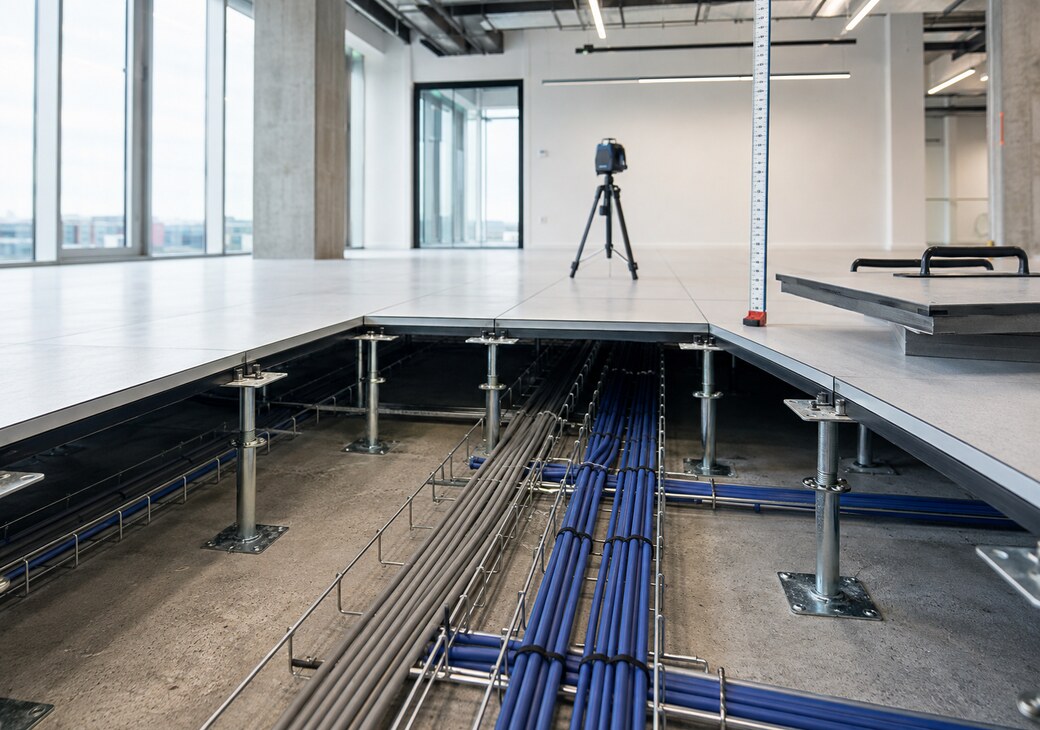
When choosing a raised access flooring system, one of the most important factors is ensuring the floor meets the correct performance standards. In the UK, two specifications dominate the industry: PSA MOB PF2 PS/SPU and the European standard BS EN 12825. Each system defines how raised floors are built, tested, and classified — and which environments they are suitable for.
This guide provides a clear, customer-friendly explanation of both standards, the differences between them, where each is typically used, and how to choose the correct floor grade for your project.
View PSA and BS EN 12825 certified panels, pedestals and accessories — all available for fast UK delivery.
1. What Is PSA MOB PF2 PS/SPU?
PSA MOB PF2 PS is the long-standing UK government performance specification for raised access flooring. For over 20 years, it has been the benchmark for commercial offices, public sector buildings, computer rooms, and technical spaces. The latest version, published in 1992, is known as MOB PF2 PS/SPU, where “SPU” means Single Project Use.
Unlike a product description, PSA is a performance-based specification: every panel, pedestal, and supporting component must pass a series of controlled tests to confirm strength, durability, safety, and build quality.
PSA Covers:
- Dimensional tolerances (panel size accuracy)
- Movement under humidity and temperature changes
- Concentrated load capacity on 25mm and 300mm squares
- Uniformly distributed load (UDL)
- Fire safety and spread of flame
- Panel finishes (e.g., steel, HPL, vinyl)
- Electrical bonding & earthing continuity
These tests ensure the raised floor performs predictably under real-world conditions, particularly in office and IT environments where heavy equipment may be present.
2. PSA Load Grades Explained
PSA MOB PF2 PS/SPU defines four performance grades. Each grade reflects different load requirements and typical areas of use.
PSA Grades & Structural Performance
| Grade | Typical Use | Concentrated Load (300mm) | Concentrated Load (25mm) | UDL | Safety Factor |
|---|---|---|---|---|---|
| Light | General office environments | ≥ 2.7kN | ≥ 1.5kN | ≥ 6.7kN/m² | 3 × load for 5 minutes |
| Medium | Offices with heavier equipment, public spaces, education | ≥ 4.5kN | ≥ 3.0kN | ≥ 8.0kN/m² | 3 × load for 5 minutes |
| Heavy | Computer rooms, comms rooms, telecom spaces | N/A | ≥ 4.5kN | ≥ 12kN/m² | 3 × load for 5 minutes |
| Extra Heavy | Data centres, print rooms, heavy equipment zones | N/A | ≥ 4.5kN | ≥ 12kN/m² | 2 × load for 5 minutes Plus 11kN four-point loading test |
Plain English: Light = offices. Extra Heavy = data centres and critical equipment.
3. What Is BS EN 12825?
Introduced in 2001, BS EN 12825 is the European standard for raised access flooring. It is mandatory for public projects and widely specified in high-performance commercial buildings and data centres.
Unlike PSA (which gives fixed grades), BS EN 12825 is based on:
- Ultimate load (failure point)
- Working load deflection (2.5mm, 3mm, 4mm)
- Safety factor (2 or 3)
- Dimensional tolerances
This allows engineers and specifiers to select an exact performance class rather than a general grade.
A practical example is the TopFloor GWT Fusion BS EN 12825 access floor panel . Depending on the specified TopFloor pedestal and crossbar arrangement, the complete tested system can achieve EN 12825 Class 5A or Class 6A performance.
4. BS EN 12825 Classification System
BS EN 12825 uses a four-part performance code, for example:
• 3 = Ultimate load above 8kN
• A = Deflection under 2.5mm
• 3 = Safety factor of 3
• 2 = Dimensional tolerance class
5. PSA vs BS EN 12825: Key Differences
| PSA MOB PF2 PS/SPU | BS EN 12825 |
|---|---|
| UK-focused standard | Mandatory for public & government projects |
| 4 fixed grades | Custom performance classes |
| Office-focused | High-load & critical environments |
Our specialists can assess your equipment loads, void height and usage to specify the correct PSA or BS EN 12825 system.
Get Expert AdviceSpeak to a flooring specialist